
Alexis MATA – Encrypted Dreams 2023| Oil on canvas | 70.9 × 59.1 inches
Welcome back to At the Studio Table.
Last week the Salon received an early look at available work by Alexis Mata alongside the argument for why this particular moment, and this particular practice, matters to collectors. This is the expanded version of that argument, now public. If you want to be in the room where those conversations happen first, the Salon is where they live.
I want you to pay attention to the years in this argument. They are not incidental. The sequencing is the point and it is exactly why this is a very interesting moment to be a collector. 2019, 2023, 2024 and now 2026.
A note before we begin: mentorship at Lion & Lamb closes May 1st. If you are an artist and have an interest, reach out directly at info@lionandlamb.art.
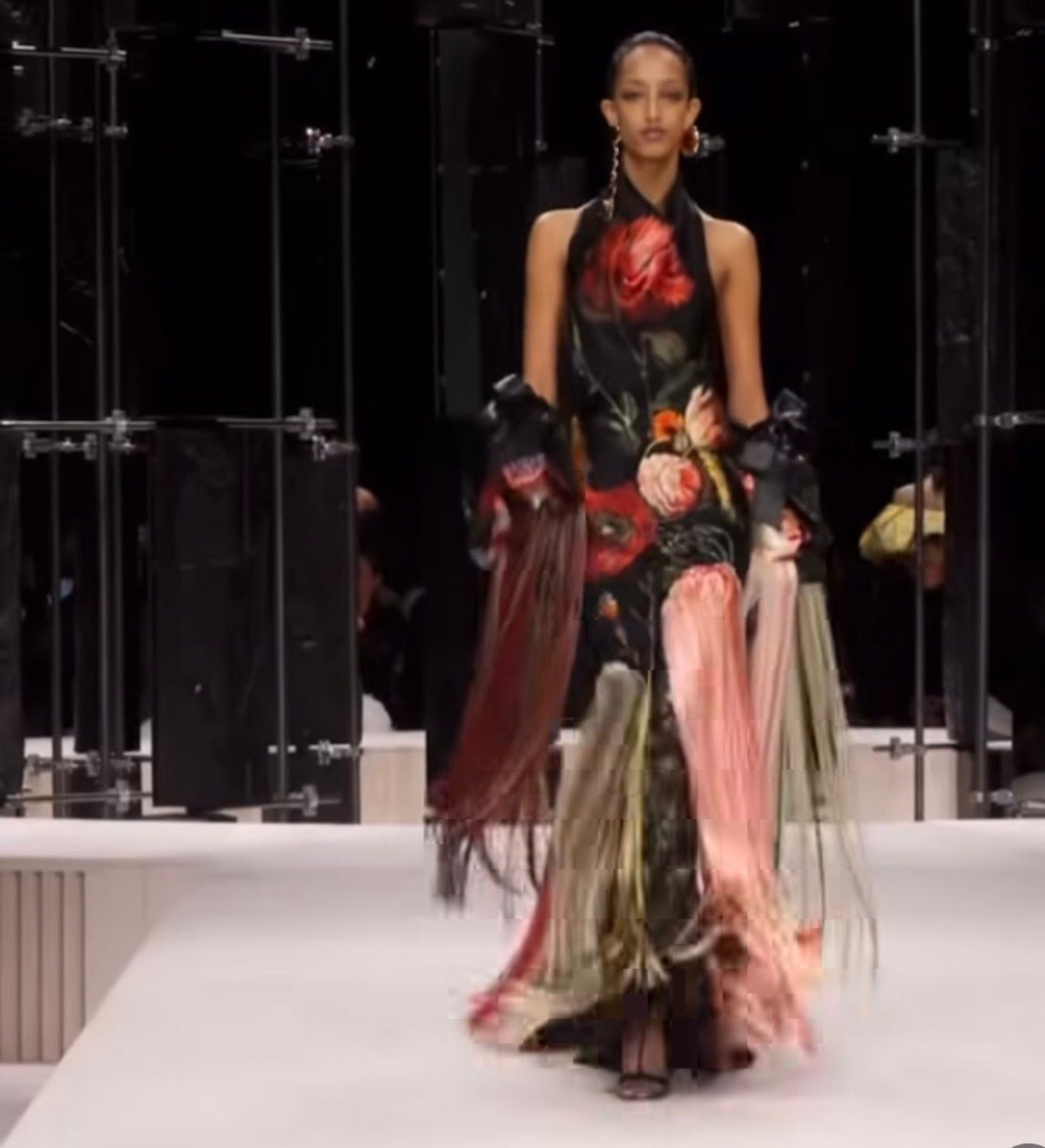
Sarah Burton FW26 for Givenchy – terrible screenshot from instagram (I am sorry).
Three weeks ago, Sarah Burton closed her Givenchy Fall 2026 show with a gown that stopped the room. Dense botanical jacquard, poppies, roses, tulips rendered with the fidelity of a Dutch Golden Age still life, dissolving at the hem into loose hanging yarn, the colors of the flowers dripping downward in long vertical threads, as if the image were corrupting in real time. The room read it as painterly. As digital. As both.
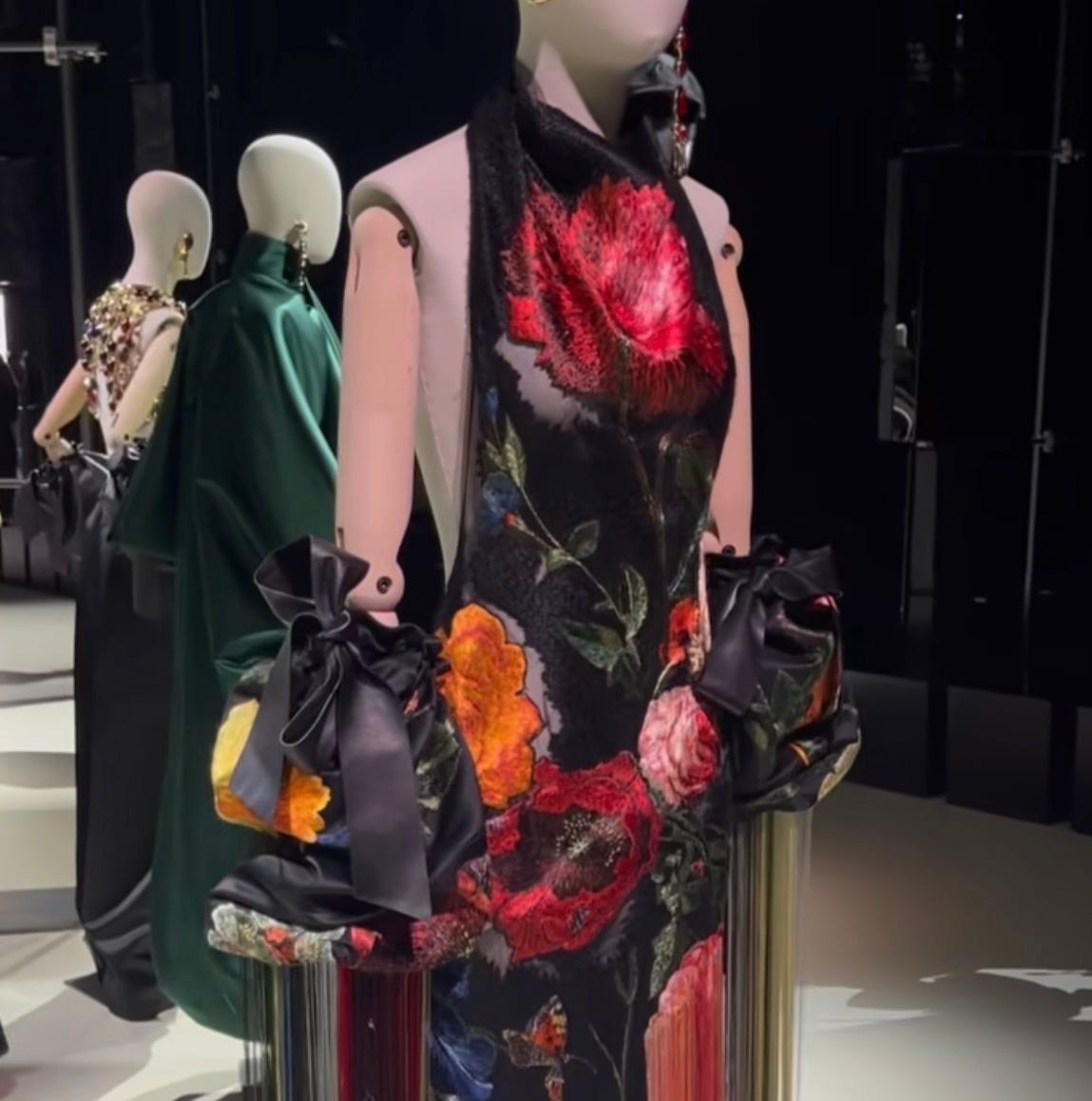
It was neither. The source was a hand-painted canvas by Filipino artist Olan Ventura, who has spent years making acrylic paintings that faithfully replicate 17th-century Dutch floral compositions and then introduce what he calls glitches, streaks of pigment that shoot off the edge of the canvas as if the image file is failing. Entirely hand-made. No AI. No digital tools. A man, a brush, and a question about what happens when the logic of one era’s technology gets applied to another era’s image.
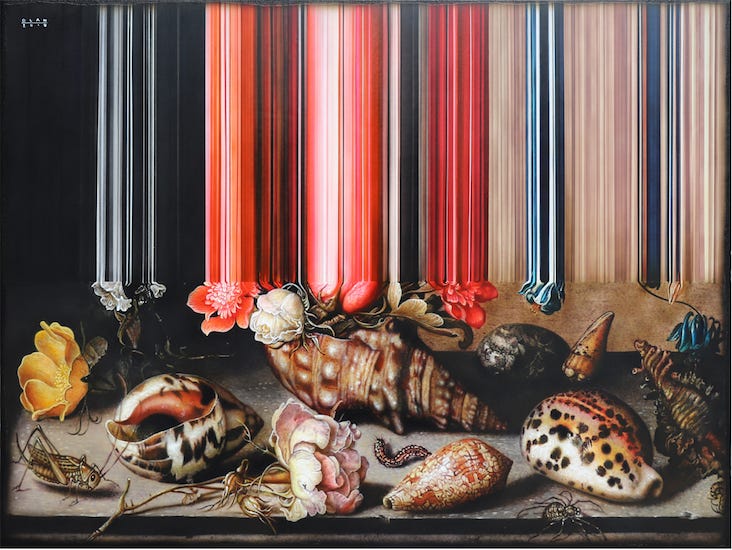
Olan Ventura- Still Life of Flowers, Shells and Insects, 2019, acrylic on canvas, 76.2 x 101.6 cm. All images courtesy of the artist, the Working Animals Art Projects and Yavuz Gallery
Burton saw it. Understood it. Put it on a runway body and walked it in front of four hundred editors, and the room still couldn’t quite agree on what they were looking at.
That perceptual instability is not a side effect of this moment. It is the condition of it.
At the same Paris Fashion Week, Anrealage’s Kunihiko Morinaga sent models down the runway in garments embedded with ten thousand individually programmable LEDs that dissolved the figure into the projected backdrop in real time, clothes that made the body disappear. The collection included kaleidoscopic florals and AI-generated imagery translated into jacquard. It was unambiguously technological, visually spectacular, and looked, in places, remarkably similar to Ventura’s hand-painted canvases.
You couldn’t tell by looking. That’s the point.
The visual surface has stopped being a reliable signal for how something was made. And that means the question the art market has been arguing about, hand or machine, authentic or generated, real or synthetic, is the wrong question. Or rather, it is a question that can no longer be answered with the eye alone.
Which means the eye was never the whole story. It just took this moment to make that legible.
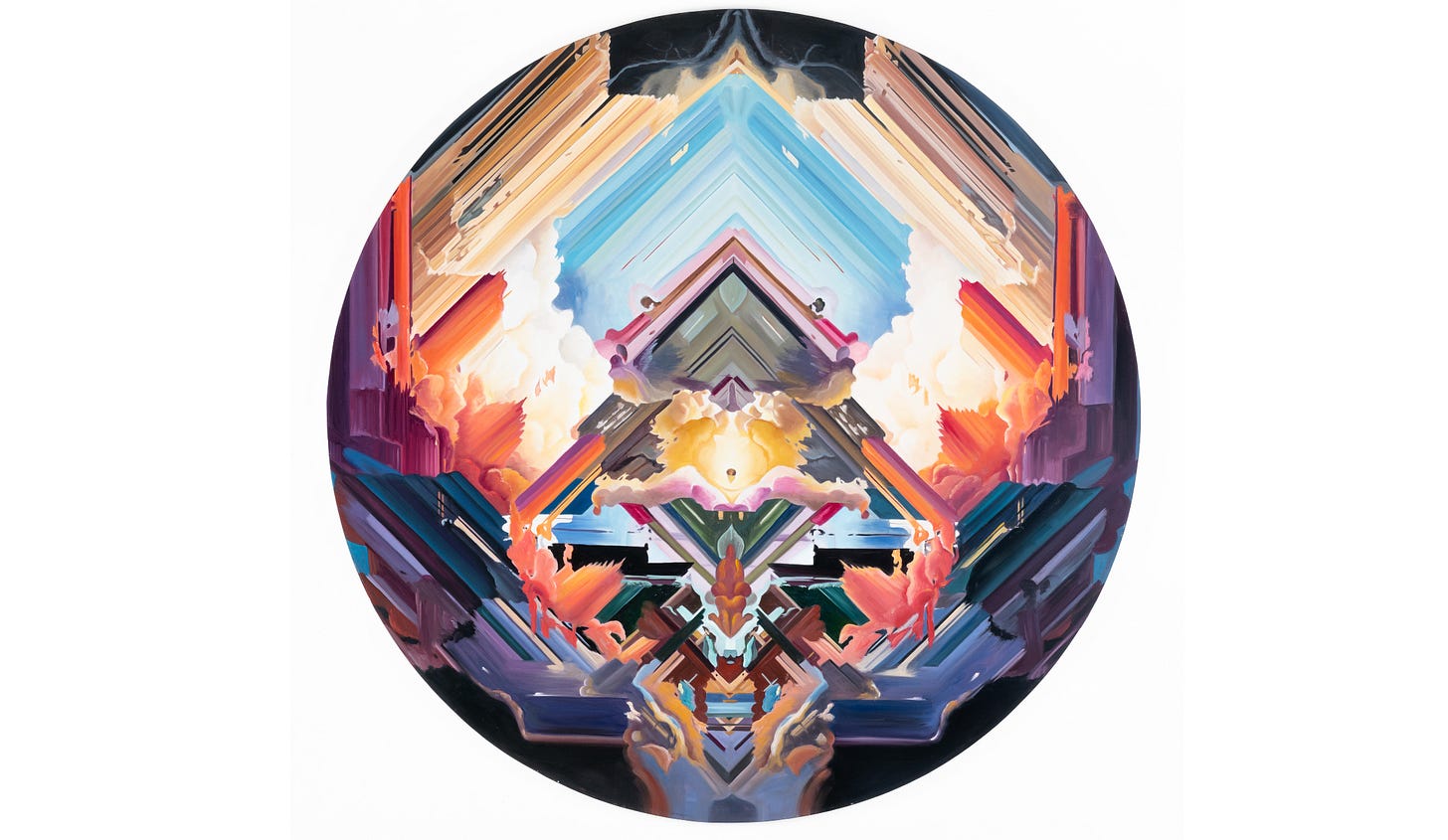
Alexis MATA – Nebulosa circular, 2024| Oil on canvas | 58 inches
The conversation about AI and art has been dominated by two camps: artists who feel threatened by replacement, and technologists who are excited about it. Both are focused on the wrong question.
The question was never whether AI would replace human authorship. The question is what happens when a serious artist, one with a specific history, a specific dream life, a specific aesthetic intelligence built over decades, enters into genuine dialogue with a system that contains the collective deposit of human visual culture. That is a different question entirely. And a small number of artists were already living inside it before it became a flashpoint. Alexis Mata is one of them.
Born in Mexico City in 1981, Mata has spent over two decades building a practice rooted in a single persistent inquiry: what is lost, transformed, and generated when information crosses between formats? He began in public intervention and urban space, moved through collage, painting, and installation, and has shown at Museo Tamayo, Museo Jumex, Museo Carrillo Gil, The Hole NYC, Soze Gallery Los Angeles, and institutions across Europe and Latin America. This is not an emerging artist chasing a trend. This is a mature practice that arrived at new tools through its own internal logic. What he is doing is worth understanding.
Mata meticulously documents dreams, sensations, and landscape experiences, in text, poems, drawings, photographs. He then enters into a structured dialogue with AI, feeding it limited, self-referential information. What returns is something that concentrates his references alongside everything humanity has deposited into the system, functioning, in his words, as an analogy of the collective unconscious. He then edits, reworks, and uses that output as a reference point for large-scale oil paintings on canvas.
The hand is present. The intention is present. The tool is a pressure applied to the work, not a replacement for it.
That institutional backing, Museo Tamayo, Museo Jumex, is not decorative. It insulates Mata’s work from the boom-bust cycle of commercial gallery discovery in a way that pure gallery representation rarely does.
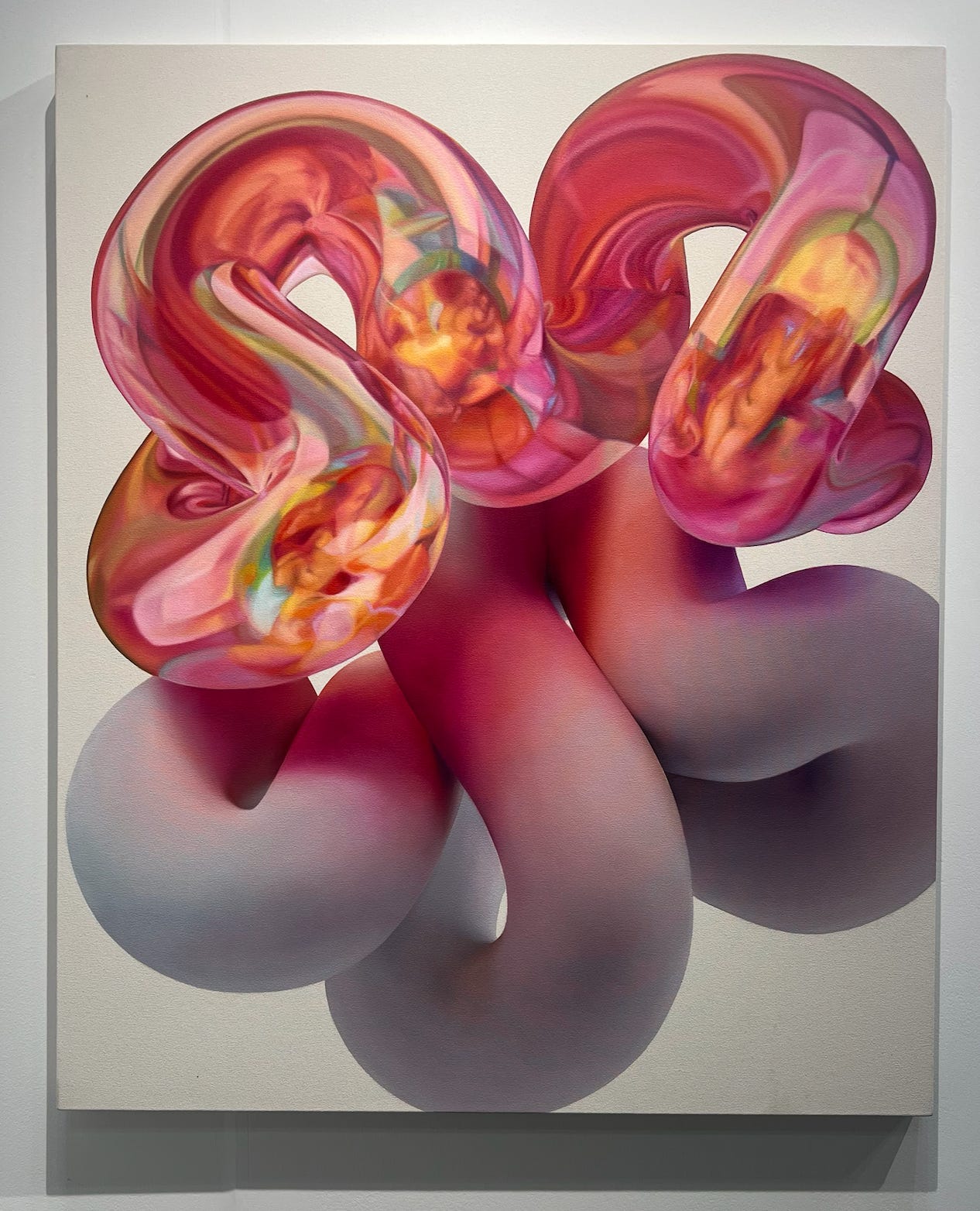
Anna Vainionpää – Soft Body Dynamics 99,2023 – work at Amory in 2024 with the Hole NYC
The Distinction That Matters
The market hasn’t caught up to this yet, and that gap is worth naming plainly.
Canadian-Finnish painter Anna Vainionpää has built a serious practice using eye-tracking hardware to capture how viewers’ eyes move across historical paintings of female nudes, Rubens, Tintoretto, then feeds that movement data into generative 3D software and paints the resulting forms in oil. The work is rigorous. The conceptual framework is coherent and considered. It deserves its institutional attention.
Vainionpää’s process runs through the viewer. She is harvesting the external gaze, what other people look at, and where, and for how long, and translating that data into form. The source material is collective. The input is other people’s looking.
Mata’s process runs in the opposite direction. He feeds his own dream life inward, his sensations, his landscapes, his self-referential experiences, and uses AI as the pressure that pushes that interiority into visible form. The technology is present in both cases. The source is not.
The real question is whose interiority is doing the work, and what was genuinely at stake when the canvas was started. That is the lens. That is what matters when you are deciding what to collect and why.
Consider where these artists sit in the market right now. Olan Ventura, whose hand-painted glitch canvases Burton just carried down the Givenchy runway in front of every serious buyer and editor at Paris Fashion Week, is represented by Whitestone Gallery, with locations in Tokyo, Hong Kong, Taipei, Singapore, and New York. That moment will reprice his work. It already may have.
Mata is represented by Soze in Los Angeles and has shown at Museo Tamayo, Museo Jumex, The Hole NYC, and institutions across Latin America and Europe. The institutional credibility is equivalent. The collector awareness is not, yet.
That gap is where the opportunity lives.
The works being made during a cultural controversy become its historical record through the seriousness of the inquiry that preceded it, not the controversy itself. The artists who were already philosophically equipped to engage a territory before it became a flashpoint are the ones whose work carries the weight of genuine inquiry rather than response. Mata was already here. That distinction matters.
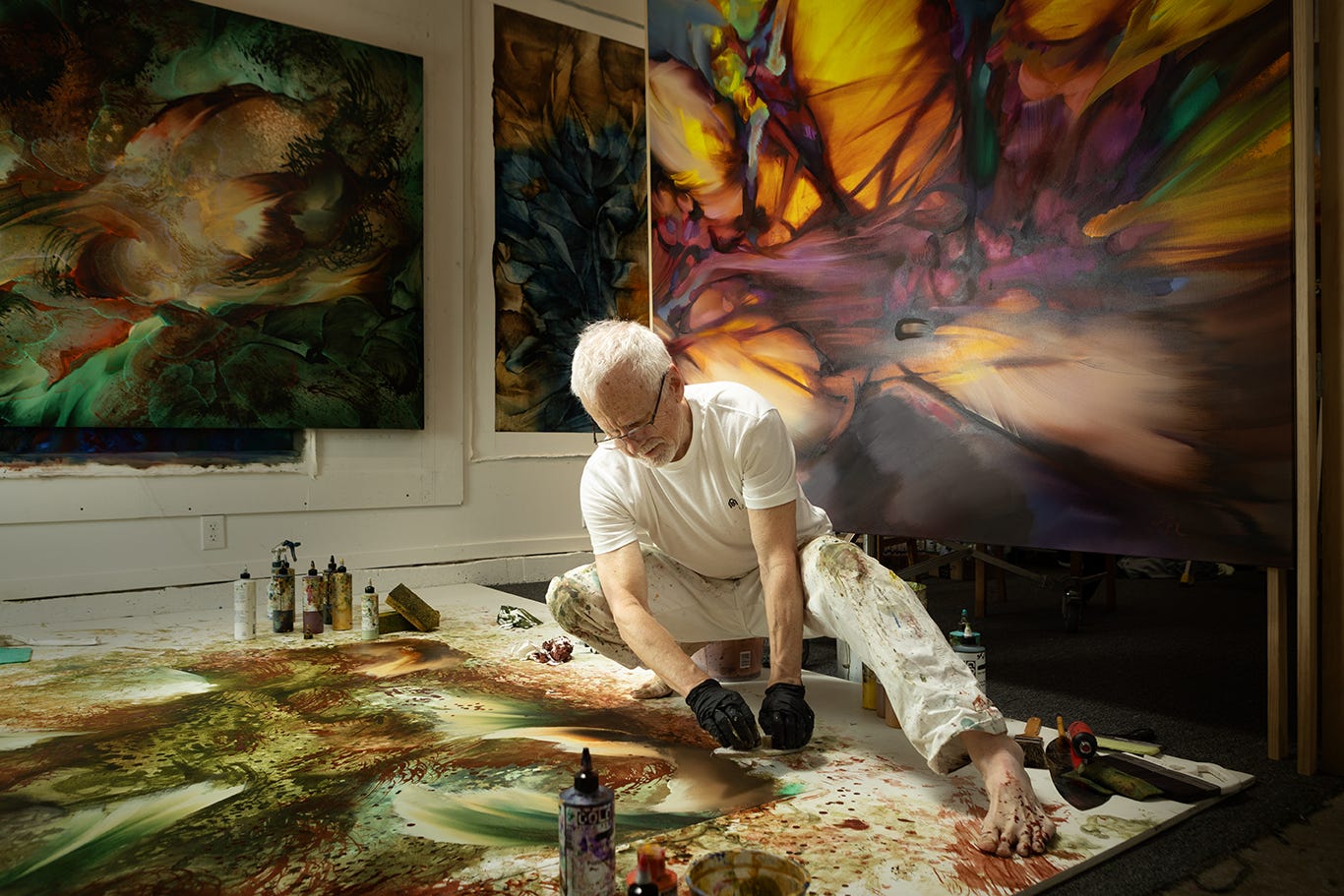
Kevin Costely in his studio
The Artist You Almost Wouldn’t Know To Look For
“There are places I can feel but are impossible for me to name.”
That’s Kevin Costley, describing his own work. He’s been painting for decades out of Seattle, building a practice in relative quiet, no major gallery representation, no institutional machinery behind him.
The paintings feel uncovered rather than constructed. The layering has geological depth, you’re looking at something that has time inside it, real accumulative time, the kind that can’t be programmed or prompted or accelerated. What looks purely expressive is actually highly controlled. There is violence and tenderness in the same surface simultaneously. The central forms feel inevitable. They don’t ask for attention. They exert gravity.
This is what it looks like when someone has spent a lifetime learning to paint and has nothing left to prove. The urgency is real because it came from a body and a biography, not a brief. The movement is real because it was found, not designed, Costley works without a fixed outcome, letting forms emerge the way weather forms patterns, or the way memory drifts into focus. His own description of the process: painting at the edge of chaos, where wonder and control are always in motion.
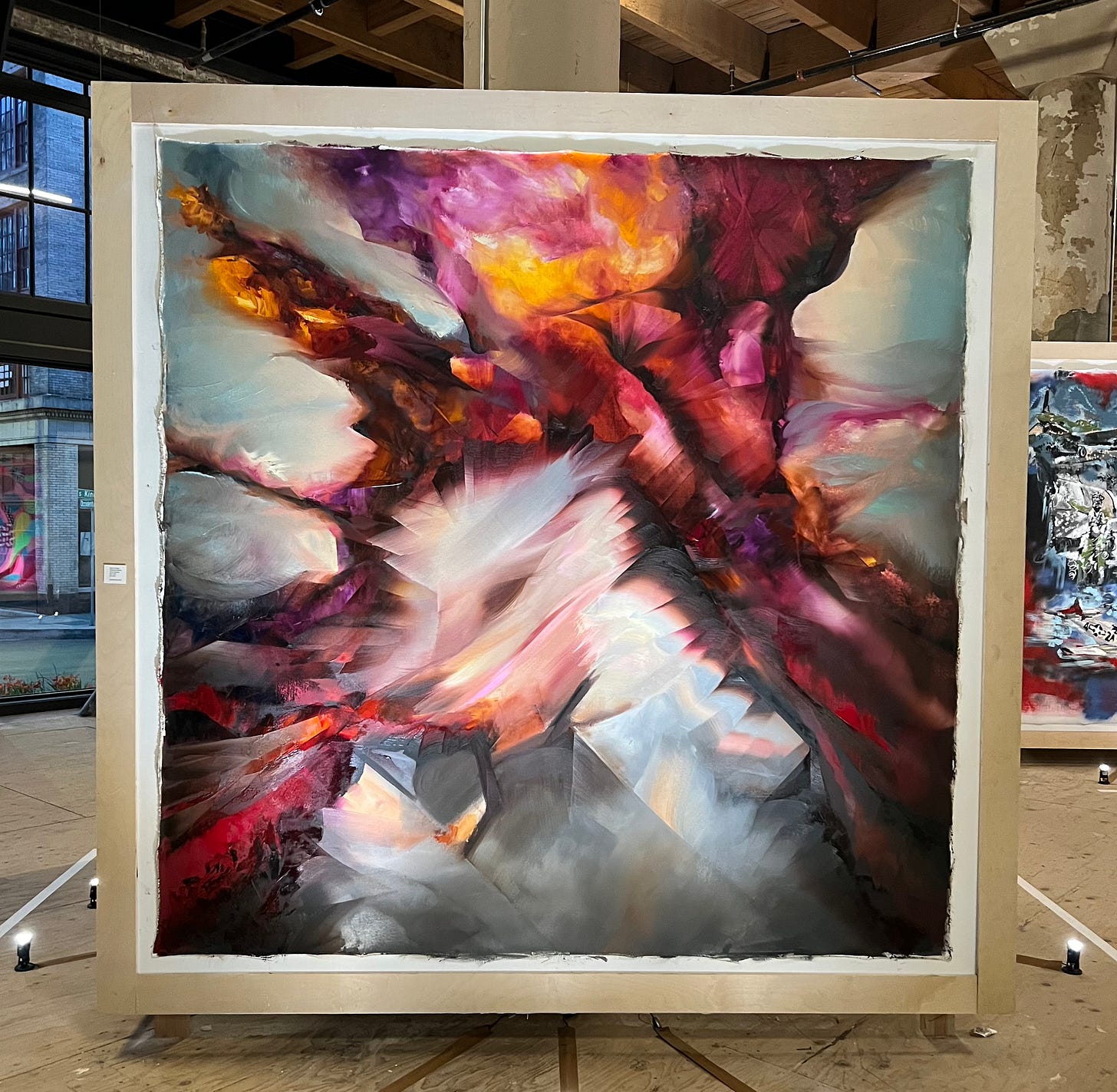
Installation of Costley’s work
The work doesn’t sit passively on the wall. It activates the room.
What does it mean to collect this? You are buying something made by a serious artist at the height of his powers, in a window that is what it is. The market hasn’t found him yet much like Mata, Lion & Lamb has.
What struck me when I first saw Kevin’s paintings was the feeling of them being alive , churning, breathing, billowing, exploding. I have seen a lot of artwork in my lifetime. I have never seen anything like this. As if it is both pulling and expelling you simultaneously, existing like a galaxy far away, indifferent to your feelings about it. Power reeling, expanding, collapsing, in bright colors, gradients, textures, violence, softness.
It is a piece that forces you to confront it. Like a portal tearing through time and space. Undeniable. Unapologetic in its infinite and finite form. Meditative in its indifference to you, you lose yourself in it. It raises existential questions about life, about purpose.
It is beautiful. It is so very Pacific Northwest, that particular combination of mystery and seriousness, decay and life, the forest and the fog and something underneath both that refuses to be named. Ancient.
Why is art like this worth collecting? Why is any of it, Costley, Mata, worth the money, the time, the consideration?
Because it makes you feel something. Because it demands. Because it creates the conditions for feeling in a moment when collectively we are dulling, drowning in the numbness that abundance, politics, and global life require of us. Work like this is piercing. It cuts through. And that is not a small thing right now. That is everything.
The conversation about AI in art will resolve. The market will reprice. The visual confusion will eventually produce new literacy collectors and institutions will develop better tools for reading what they’re looking at and why it matters.
That resolution is not here yet. And the sequencing of this particular moment is worth sitting with.
Ventura made that painting, Still Life of Flowers, Shells and Insects, in 2019, three years before AI image generation was a cultural flashpoint. Mata was already building his dream-documentation process before it was a controversy. Vainionpää’s eye-tracking work predates the debate entirely. The runway moment that stopped a room in Paris in 2026 was sourced from a canvas made seven years ago.
Ventura’s market is repricing now. In real time. That is what a seven year head start looks like when the culture finally catches up.
Mata and Costley are at that same position, serious practices, serious inquiry, ahead of the mass recognition. Costley’s work is available under six thousand dollars. Mata’s work sits above ten. Two completely different entry points into the same argument. Two completely different relationships to reference, medium, and land. Both creating alien dreamscrapes. Both available now, before the market catches up.
That is what this season is about. That is what we open with May 1st, a dare. Daring you, dear reader, to feel something. And to really let yourself free fall into the depth of that. Because if you do, you may be surprised at what you discover there and how that transforms seven years later.